
A new multi-disciplinary team aims to automate complex sample handling at Beamline 7.3.3, leveraging AI and robotics to speed up material optimization and discovery. Read more »
ALS Computing Group Brings Machine Learning Models to Beamtimes around the World
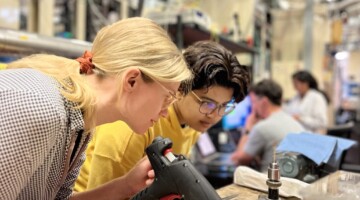
The ALS computing team is developing tools to help users make the most of their beamtime and eliminate bottlenecks that currently exist. They have been traveling around the world and collaborating across facilities to develop advanced data processing solutions that will yield more meaningful data. Read more »
“Computer Vision” Review of X-Ray Movies Leads to New Insights

Using a type of machine learning called “computer vision” to mine data from x-ray movies, researchers made new discoveries about the reactivity of a material in rechargeable batteries. The results suggest that optimizing the carbon layer thickness on the electrode surface could help researchers to design more efficient batteries. Read more »
A Deep-Learning Analysis of Lithium-Plating Dynamics in Batteries
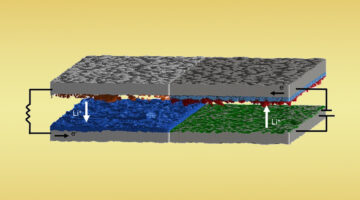
Lithium-metal solid-state batteries are a promising technology, but the deposition (plating) of lithium metal on electrode surfaces remains a significant technical hurdle. Here, researchers used micro-computed tomography data to train an artificial intelligence model to identify characteristics vital to improving battery performance. Read more »
Chatbot-Style AI Designs Novel Functional Protein

Researchers used an artificial intelligence (AI) algorithm, similar to those used in natural-language (“chatbot”) models, to design a functional protein that was then structurally validated at the ALS. The work could speed the development of novel proteins for almost anything from therapeutics to degrading plastic. Read more » 
Shaping X-Ray Mirrors Using Machine Learning
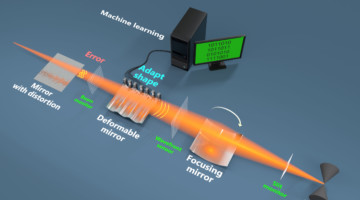
Researchers used machine learning to predict and control the shape of an x-ray mirror’s surface with exquisite accuracy and precision. The work represents a key step toward mirrors that can fully exploit the x-rays from upgraded, state-of-the-art light sources and could also enable the engineering of x-ray beams with novel characteristics. Read more »
A Machine-Learning Approach to Better Batteries
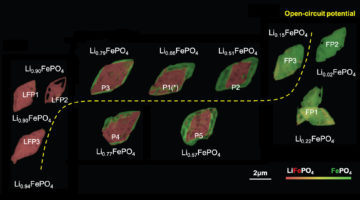
Researchers extracted the relationship between strain and composition in a battery material by applying machine-learning methods to atomic-scale images. The work could lead to more durable batteries and also highlights the potential of integrating microscopy techniques with machine learning to gain insights into complex materials. Read more »
Machine-Learning Team Receives 2021 Halbach Award

This year’s Halbach Award for Innovative Instrumentation at the ALS went to a team of accelerator physicists and computer scientists who were able to use machine-learning techniques to solve a problem that has plagued third-generation light sources for a long time: fluctuations in beam size due to the motion of insertion devices. Read more »
Autonomous Data Acquisition for Scientific Discovery

Researchers at large scientific facilities such as the ALS have applied a robust machine-learning technique to automatically optimize data gathering for a variety of experimental techniques. The work promises to enable experiments with large, complex datasets to be run more quickly, efficiently, and with minimal human intervention. Read more »
X-Ray Experiments, Machine Learning Could Trim Years Off Battery R&D
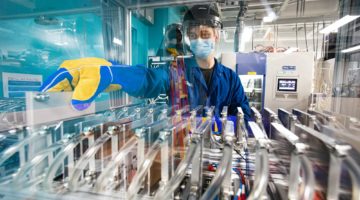
Scanning transmission x-ray microscopy at the ALS’s COSMIC beamline contributed to a battery study that used an innovative approach to machine learning to speed up the learning curve about a process that shortens the life of fast-charging lithium batteries. It represents the first time this brand of “scientific machine learning” was applied to battery cycling. Read more »